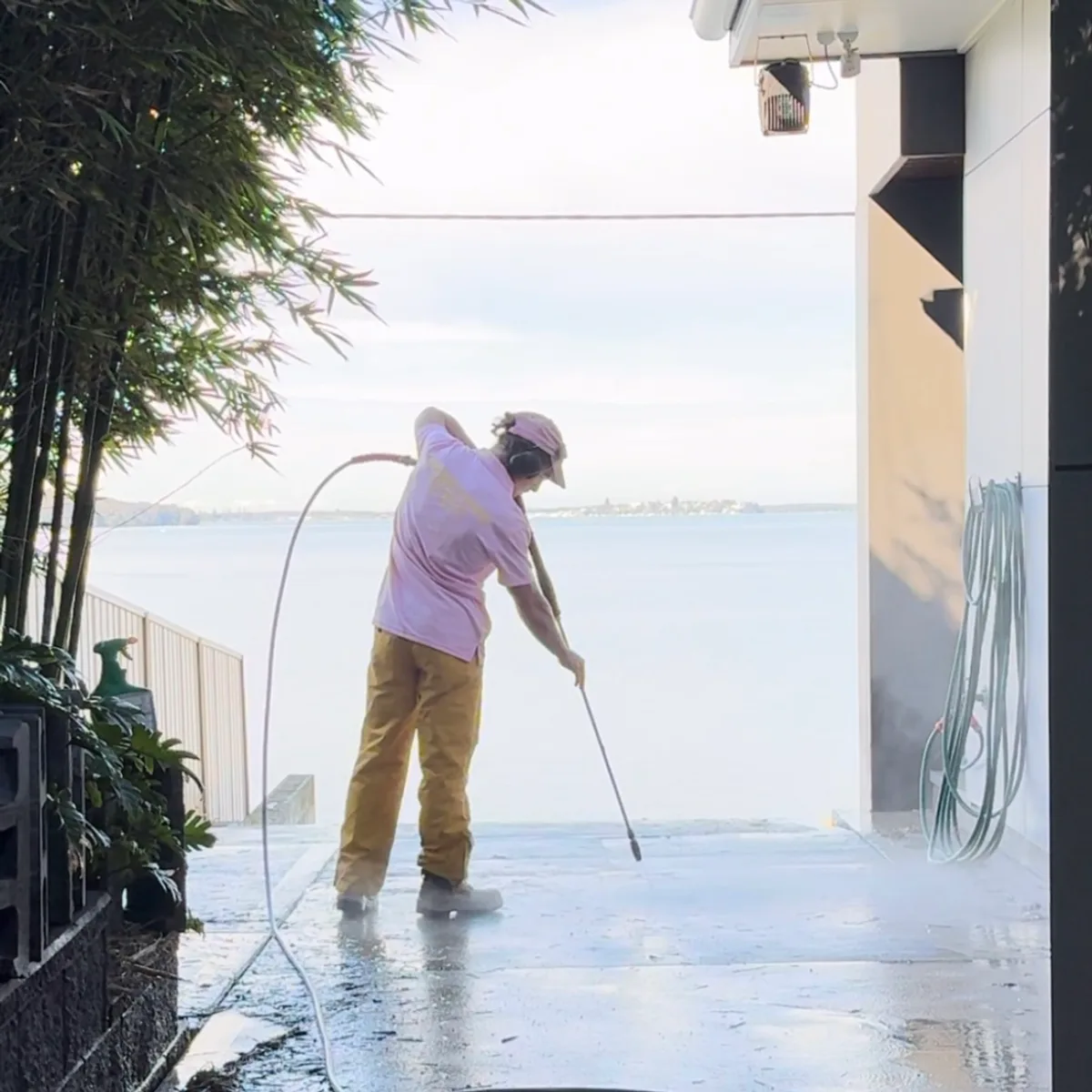
Every surface around a Newcastle home has a different safe PSI ceiling. Timber decking tops out at 1200-1500 PSI, concrete driveways handle up to 3500 PSI, and roof tiles take 0 PSI. Roofs need a soft wash instead. Get the number wrong and you either gouge the surface or waste hours pushing dirt around with water that is not doing any work.
Our complete pressure washing guide for Newcastle homes covers safe PSI at a glance. This guide goes deeper into the nozzle angle, the distance, the pass technique, and the specific mistakes that turn a technically safe PSI number into a damaged surface anyway. It also settles the question most homeowners get wrong first: whether a bigger PSI number is actually better. We have used every range below on real Newcastle properties, not copied it off a manufacturer spec sheet.
Is a Higher PSI Always Better, or Does Water Flow Matter More?
No. Among professional operators, the common view is that PSI only breaks dirt loose. Water flow, measured in gallons or litres per minute (GPM), is what carries it away and makes the job faster. The shorthand passed around the r/pressurewashing community is blunt: "PSI is punch, GPM is volume."
This matters most when choosing a machine off a shelf. A narrow nozzle squeezes the water, so the PSI number climbs while the actual flow drops. The tip is trading flow for pressure, not adding cleaning power. A wider nozzle does the reverse. The pump has a fixed ceiling for both, so the big PSI figure printed on a hardware-store box often hides a low flow rate that cleans slower, not faster.
Operators who have run both setups report the difference plainly. Moving from a 4 GPM machine to an 8 GPM machine cuts job time by roughly 30-40%, at the same or lower PSI. More water across the surface clears the loosened grime in one pass instead of three.
For a Newcastle homeowner the takeaway is practical. Chasing the highest PSI on the box is the wrong instinct. A surface only needs enough PSI to lift its dirt safely, and past that, extra pressure just adds damage risk without cleaning any faster. Flow, technique, and the right nozzle do more real cleaning than a bigger pressure number ever will.
That is also why a professional rig cleans a salt-and-moss-covered Newcastle driveway faster and more gently than a high-PSI consumer unit. It moves far more water, so it never needs to crank the pressure up to the surface's damage threshold to get a result. With that settled, here is the safe PSI ceiling for each surface around a Newcastle home.
What PSI Is Safe for a Timber Deck?
Hardwood decking tolerates up to 1500 PSI. Spotted gum and blackbutt, both common on Newcastle decks, sit in that hardwood band. Treated pine and softer timbers should stay under 1000 PSI, in line with Forest and Wood Products Australia's timber maintenance guidance. Go above that range and water forces its way into the grain. It raises the fibres and leaves a rough, fuzzy surface that needs sanding to fix.
Use a 25-40° fan tip, never a rotary "turbo" nozzle. The concentrated jet gouges softwood in seconds and leaves visible track marks on hardwood. Keep the nozzle roughly 30cm from the boards, work with the grain rather than across it, and overlap each pass by half the fan width so you are not left with stripes once the deck dries.
Older decks with silvered, weathered timber need an extra step. Silvering means the surface fibres are already loose from UV exposure, so the same PSI that cleans a newer deck can strip away more timber than expected. Test an inconspicuous corner first, and drop 200-300 PSI below the usual range if the boards feel soft underfoot.
What PSI Is Safe for a Concrete or Paved Driveway?
Concrete and exposed aggregate handle up to 3500 PSI, the highest tolerance of any surface around a Newcastle home. Pavers and brick sit lower, at 2500-3000 PSI, because the pointing and joint sand wash out under higher force. Housing Industry Association guidance flags eroded paver joints as one of the most common pressure washing complaints homeowners raise.
A 15-25° nozzle held in constant motion is the right technique here. Hold any nozzle stationary on concrete, even at a safe PSI, and it etches a visible line into the surface within seconds. Freshly poured concrete needs 28 days to cure before it can take a pressure wash at all. For the full breakdown of when a driveway actually needs cleaning, see our driveway cleaning frequency guide.
Coloured and stamped concrete needs a further step down, to 2000-2500 PSI, with a wider fan angle than plain concrete. The colour layer sits closer to the surface than raw concrete does. A narrow, high-force nozzle can strip patches of pigment faster than it lifts dirt, and the result is a mottled, uneven finish that shows every time it rains.
Can You Pressure Wash a Roof at All?
No. Roof tiles and metal roofing take 0 PSI. A direct pressure wash strips the protective granule coating and forces water under the tile laps, which most manufacturers count as grounds to void the warranty. Safe Work Australia's guidance on high-pressure water jetting also flags roof-height work as one of the highest-risk pressure washing tasks, well above ground-level driveway cleaning.
The right method is a soft wash: a biodegradable chemical solution applied at roughly garden-hose pressure, left to dwell, then rinsed off. We cover exactly which surfaces need which method in soft washing vs pressure washing. If a company quotes a "pressure wash" for your roof, that is the moment to ask what PSI they plan to use. The honest answer is none.
This is not a grey area the way some of the other surfaces are. There is no "low PSI, done carefully" version of pressure washing a roof that is safe. The tile coating and the membrane underneath are simply not built for direct force, whatever nozzle or distance you use.
What PSI Is Safe for a Timber or Colorbond Fence?
Timber paling fences follow the same range as decking: up to 1500 PSI for hardwood palings, under 1000 PSI for treated pine, wide fan tip only. Colorbond and other painted steel fencing is more fragile than it looks. BlueScope's care guidance for COLORBOND® steel recommends against directing a high-pressure cleaner straight at the surface at all, in favour of a low-pressure rinse with a mild detergent.
Painted steel that has been pressure washed at close range often shows a dulled, patchy finish where the coating has thinned unevenly. The damage shows up weeks later, not immediately, which is why it gets blamed on weathering instead of the clean that caused it. Fence lines on the ocean side of a Newcastle suburb are already under more coating stress from salt spray, so they are where this mistake shows up fastest.
Why Newcastle's Climate Pushes These Numbers Down, Not Up
Newcastle's coastal air stays humid year-round, and salt-laden moisture wears at timber and steel coatings faster than an inland climate does, according to Bureau of Meteorology regional data. A deck or fence in Orange or Tamworth might handle the top of its PSI range. The same deck in Newcastle should be cleaned at the lower end, because the material is already working harder against salt and humidity before a pressure washer touches it.
This is also why coastal Newcastle properties need cleaning more often at a gentler PSI, rather than less often at a higher one. The two do not trade off evenly. Pushing PSI up to make up for a longer gap between cleans just adds damage risk on top of the wear the climate has already caused. Suburbs closer to the water, like Stockton, Merewether, and The Hill, see this fastest, because salt exposure there is constant rather than seasonal.
What Happens When You Go Over the Safe PSI Range?
Damage from excess PSI is rarely instant on hard surfaces, and on soft ones it often stays invisible until weeks later. Standards Australia water jetting guidance notes that surface damage from high-pressure equipment is cumulative. Repeated passes at too high a PSI compound the wear, even when a single pass looks fine.
- Concrete: pitting and exposed aggregate where none was intended
- Pavers and brick: eroded joint sand and loosened pointing
- Timber: raised grain, splintering, and grey "fuzz" that catches on bare feet
- Render: hairline cracking that widens with the next rain
- Painted steel and weatherboard: thinned, patchy coating that peels early
None of these are fixed by a second clean. They need a tradesperson, and in most cases the surface needs replacing, not repairing. On a recent Merewether job, a homeowner had run a rented turbo-nozzle unit on a treated pine fence at close range. The fuzzed timber grain across three panels needed full replacement, not a repeat wash.
Safe PSI by Surface: Quick Reference
- Concrete and exposed aggregate driveways: up to 3500 PSI, 15-25° fan tip
- Coloured or stamped concrete: 2000-2500 PSI, wide fan tip
- Pavers and brick: 2500-3000 PSI, 15-25° fan tip
- Hardwood decking and fencing: up to 1500 PSI, 25-40° fan tip
- Treated pine and softwoods: under 1000 PSI, 25-40° fan tip
- Painted render and weatherboard: under 1000 PSI, or soft wash instead
- Colorbond and painted steel fencing: soft wash or low-pressure rinse only, no direct jet
- Roof tiles and metal roofing: 0 PSI, soft wash only
How Do You Know What PSI Your Machine Is Actually Producing?
Most consumer electric pressure washers sit between 1300 and 2000 PSI out of the box. Check the specification plate on the unit itself, not the marketing PSI figure on the box, which is often a peak rating rather than the actual operating pressure. Professional petrol units used for concrete and driveway work run 3000-4000 PSI, well above what most homeowners should handle without training, in line with Cement Concrete & Aggregates Australia equipment guidance for surface cleaning.
If you are renting for a single driveway job, ask the rental company for the actual PSI rating in writing rather than trusting the model name. "Heavy duty" and "3000 PSI" are not the same guarantee. A nozzle swap can change the pressure hitting the surface more than the machine's rated PSI does, which is why technique matters as much as the number on the unit.
Get the Right PSI for Your Newcastle Property
We have cleaned more than 150 homes across Newcastle since starting three years ago, and we match PSI to the surface on every job rather than running one setting for everything. For a fixed-price quote on pressure washing, roof soft washing, or fence and deck cleaning, call 0405 371 116 or contact us online. We respond within 2 hours during business hours.
Frequently Asked Questions
What PSI is safe for pressure washing a timber deck?
Hardwood decking such as spotted gum or blackbutt tolerates up to 1500 PSI with a wide fan tip. Treated pine and softer timbers should stay under 1000 PSI. Going higher raises the timber grain and leaves a rough surface that needs sanding to fix.
What nozzle should I use to pressure wash a driveway?
A 15-25° fan tip nozzle kept in constant motion is correct for concrete and pavers. Holding any nozzle stationary, even at a safe PSI, etches a visible line into the surface within seconds, regardless of the pressure setting.
Can I pressure wash a Colorbond fence?
Not directly. Painted steel fencing needs a low-pressure rinse with mild detergent rather than a direct high-pressure jet, per BlueScope's COLORBOND steel care guidance. Close-range pressure washing thins the paint coating unevenly, showing up as dulled patches weeks later.
What happens if I use too much PSI on render?
Excess PSI drives water into hairline gaps in render, and the cracking that follows widens with the next rain rather than repairing itself. Render should be cleaned under 1000 PSI, or soft washed instead if it already shows any cracking.
How do I know what PSI my pressure washer actually produces?
Check the specification plate on the unit, not the number printed on the box, which is often a peak figure rather than the operating pressure. Most consumer electric units run 1300-2000 PSI; professional petrol units run 3000-4000 PSI.
Is a higher PSI always better for cleaning a surface?
No. Once dirt lifts off at a given PSI, more pressure only adds damage risk without cleaning any faster. Matching PSI to the surface, not maximising it, is what protects concrete, timber, and painted finishes long-term.
Is PSI or GPM more important for pressure washing?
Both matter, but many professional operators argue flow (GPM) does more of the real cleaning. PSI breaks dirt loose while GPM carries it away. A machine with a big PSI number but low flow often cleans slower than a lower-PSI, higher-flow unit.