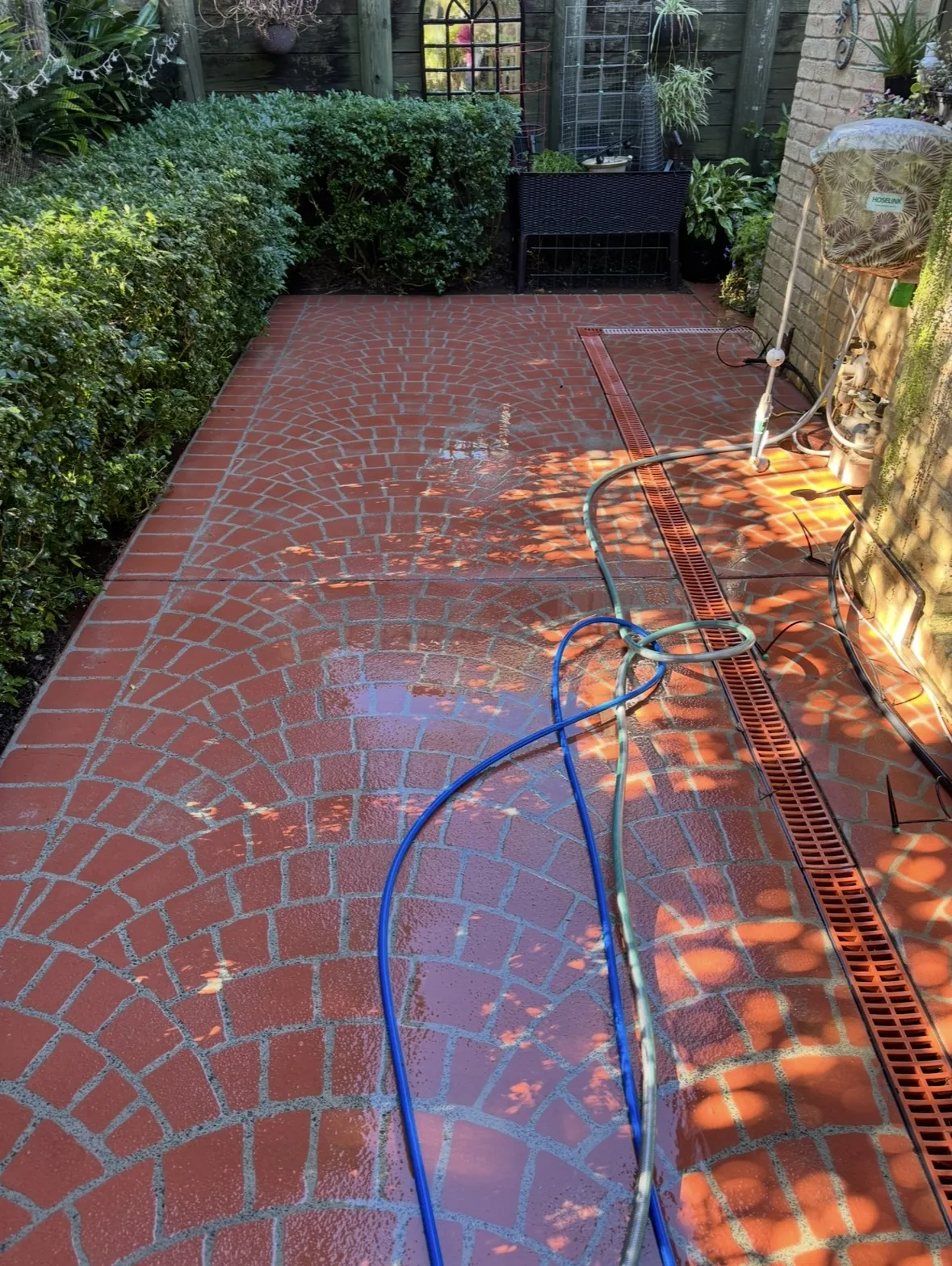
Most Newcastle homeowners clean their driveway once every three to four years. Once a year is the correct interval, and spreading that maintenance across the seasons — rather than doing everything in one weekend — protects the surface for less money, not more.
This guide covers what needs attention each season around a Newcastle property, and why timing matters as much as the clean itself.
Why a Season-By-Season Schedule Beats an Annual Blitz
Newcastle's coastal air stays humid year-round, and salt-laden moisture accelerates growth on every exterior surface, according to the Bureau of Meteorology's climate data. The algae building on a shaded driveway in July is not the same growth that builds on a roof by January. Different surfaces peak at different times of year, and a single annual clean often misses the surface that needed attention months earlier.
Booking one job for everything also concentrates the cost in a single weekend, when spreading smaller jobs across the year is usually the same total spend for a better result on every surface.
Spring (August–November): Undo What Winter Left Behind
Spring is when the damage from a wet Newcastle winter becomes visible. Moss and algae that established on shaded driveways, paths and render over winter show up clearly once the days lengthen and everyone is back outside.
Priority this season: - Driveways and paths: winter moss and algae buildup, before it stains permanently - House exterior: render and weatherboard collect the same growth, especially on the shaded southern side - Windows: six months of winter grime and pollen ahead of spring entertaining
If you only book one clean a year, spring is the season to do it. It clears the worst of the winter growth before a full summer bakes it into a stain that needs more than water to shift. For the technique and safe PSI for each surface, see our complete pressure washing guide.
Summer (December–February): Solar Output and Outdoor Living
Summer is peak solar production in Newcastle — and peak dust and pollen accumulation, which is exactly what cuts that production. A homeowner in Kotara noticed their solar output had dropped from an average of 28 kWh per day in summer to 19 kWh. The drop had been gradual enough they had not noticed until their quarterly bill came. After a panel clean, output returned to 26 kWh within a week.
Summer is when that gap costs the most, because summer is when panels are producing the most in the first place. A dirty panel in July is losing you less than the same dirty panel in January.
Priority this season: - Solar panels: dust and pollen block light directly during the highest-output months - Outdoor entertaining areas: decks, alfresco paving and pool surrounds ahead of the entertaining season - Driveways with oil staining: fresh stains lift far more easily than ones baked in over a full Newcastle summer
Summer heat also means timber decking and fencing need a gentler hand, not a harder one. Boards that have dried out over a hot spell are more prone to splintering under high PSI. Our safe PSI guide by surface covers the exact ranges for timber in this condition.
Autumn (March–May): Gutters Before the Wet Season
Newcastle's older suburbs carry heavy eucalyptus and melaleuca cover, and these species drop bark, seed pods and leaves year-round rather than in a single autumn flush. That means gutters clog on their own schedule, not the calendar's. Autumn is still the season to check them, because it is the last clear window before Newcastle's wetter winter months put that capacity to the test.
Priority this season: - Gutters: clear before the first heavy winter rain, not after it overflows - Roof valleys: leaf litter builds fastest here and is the least visible from the ground - Driveways under trees: sap and tannin staining worsens as deciduous exotics shed through autumn
A blocked gutter is not a cosmetic problem. Overflow during a downpour pushes water behind fascia boards and, on older brick veneer homes, toward the wall cavity — a repair bill that costs far more than a clean would have. Our gutter cleaning guide covers how to tell if your property needs a six-monthly schedule instead of an annual one.
Winter (June–August): Roofs, Mould, and the Coastal Effect
Winter is when Newcastle's coastal humidity does the most damage. Mould and lichen establish fastest in the cold, damp months, and coastal suburbs — Stockton, Merewether, Newcastle East — see it faster than anywhere inland. Our breakdown of why coastal homes get mould faster covers the mechanism in more detail.
Priority this season: - Roof soft washing: the growth cycle that damages tiles starts here, and treating it in winter stops it compounding through spring - Render and painted surfaces: same coastal mould risk, and the wrong method fixes nothing - Path and step safety: algae on winter-wet surfaces is a slip risk, not just a cosmetic one
Roofs never take a pressure wash, in any season. High pressure strips the protective granule coating off tiles and voids the manufacturer's warranty. Winter growth needs a soft wash instead: a biodegradable chemical treatment at low pressure, left to dwell, then rinsed off. Our soft washing vs pressure washing guide explains which surfaces need which method.
The Newcastle Seasonal Schedule at a Glance
- Spring (Aug–Nov): Driveways, house exterior, windows — clear winter moss and algae
- Summer (Dec–Feb): Solar panels, decking, entertaining areas — protect peak-season output and appearance
- Autumn (Mar–May): Gutters, roof valleys, driveways under trees — clear before the wet season
- Winter (Jun–Aug): Roof soft wash, render, path safety — treat coastal mould at its most active
Most properties do not need all four services every single season. A driveway clean once a year and a roof soft wash every three to five years is still the baseline for most homes. The season only changes which service matters most right now.
If bundling into fewer visits suits your schedule better than chasing seasonal call-outs individually, our comprehensive package covers the house, driveway, paths, windows, roof, gutters and fence in one visit, from $999. The seasonal breakdown above is about priority, not a rule that you need four separate bookings a year.
Most Driveways Are Cleaned Far Less Often Than They Should Be
The average Newcastle homeowner cleans their driveway once every three to four years. Once a year is the correct interval for most properties, and the cost difference between the two schedules is minimal. What is not minimal is the appearance and surface longevity difference: algae and moss left for three years hold enough moisture against concrete and pavers to accelerate cracking, not just staining. For the conditions that shorten or lengthen that interval, see our driveway cleaning frequency guide.
Frequently Asked Questions
How often should I book a pressure wash in Newcastle?
Once a year covers most driveways and house exteriors. Properties under overhanging eucalyptus or with a car that leaks oil often need six-monthly attention instead. Roofs need a soft wash every three to five years, and solar panels benefit from an annual clean, or sooner if output visibly drops.
What is the best season to pressure wash a driveway in Newcastle?
Spring, straight after winter. That is when moss and algae buildup from the wet season is at its worst but has not yet had a full summer to bake into a permanent stain. Waiting until summer makes the same job harder and more expensive.
Should gutters be cleaned in autumn or spring?
Autumn, ahead of Newcastle's wetter winter months. Clearing gutters before heavy rain prevents overflow that pushes water behind fascia boards. Properties with heavy overhanging eucalyptus may still need a second clean in spring.
Does solar panel output actually change with the seasons?
Yes. Summer is peak production, which means dust and pollen buildup costs the most in lost output during exactly those months. A clean typically restores output within a week, and that clean is worth the most in summer, when panels are already running at their highest output.
Can I follow this schedule with a rented pressure washer instead of a professional?
For a flat, ground-level driveway clean, renting can work. Roofs, gutters and anything at height carry a real fall risk, which Safe Work Australia's guidance on high-pressure water jetting flags as the leading hazard on jobs like these. That is where a professional with the right harness and insurance is worth the fee.
Book Your Seasonal Clean
We have cleaned more than 150 homes across Newcastle since starting three years ago, with a 98% customer satisfaction rate. For a fixed-price quote on any service in this schedule — pressure washing, roof cleaning, gutter cleaning or solar panel cleaning — call 0405 371 116 or contact us online. We respond within 2 hours during business hours.
Frequently Asked Questions
How often should I book a pressure wash in Newcastle?
Once a year covers most driveways and house exteriors. Properties under overhanging eucalyptus or with a car that leaks oil often need six-monthly attention instead. Roofs need a soft wash every three to five years, and solar panels benefit from an annual clean, or sooner if output visibly drops.
What is the best season to pressure wash a driveway in Newcastle?
Spring, straight after winter. That is when moss and algae buildup from the wet season is at its worst but has not yet had a full summer to bake into a permanent stain. Waiting until summer makes the same job harder and more expensive.
Should gutters be cleaned in autumn or spring?
Autumn, ahead of Newcastle's wetter winter months. Clearing gutters before heavy rain prevents overflow that pushes water behind fascia boards. Properties with heavy overhanging eucalyptus may still need a second clean in spring.
Does solar panel output actually change with the seasons?
Yes. Summer is peak production, which means dust and pollen buildup costs the most in lost output during exactly those months. A clean typically restores output within a week, and that clean is worth the most in summer, when panels are already running at their highest output.
Can I follow this schedule with a rented pressure washer instead of a professional?
For a flat, ground-level driveway clean, renting can work. Roofs, gutters and anything at height carry a real fall risk, which Safe Work Australia's guidance on high-pressure water jetting flags as the leading hazard on jobs like these. That is where a professional with the right harness and insurance is worth the fee.